


Horsehead Nebula B 33
-
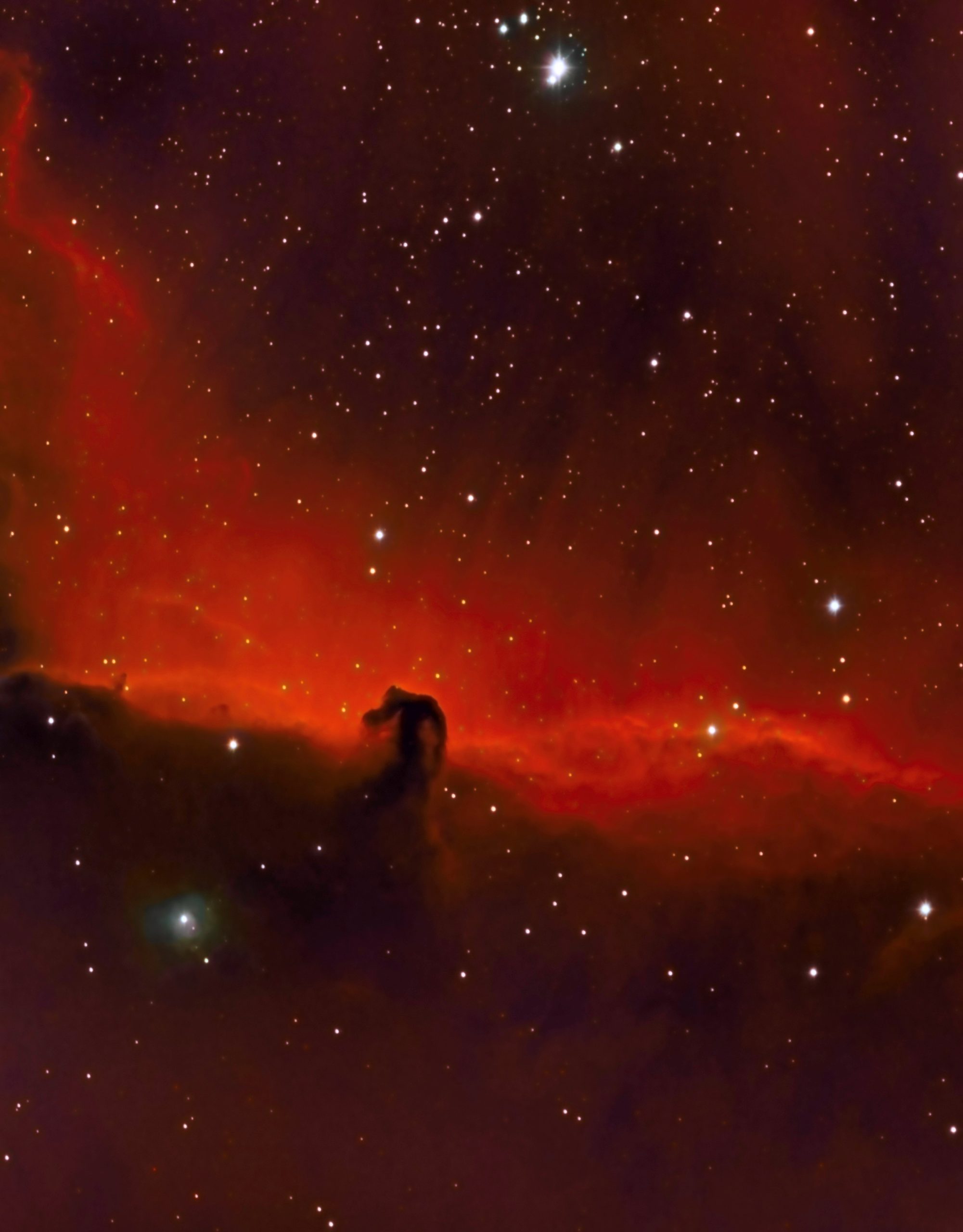
By Gary J. Becker, MD, former ABR Executive Director
Winter has just passed, but I can’t let it go without sharing with you one last iconic winter deep sky object. I acquired the 64 raw images that were used to produce the figure above at my observatory in Benson, AZ, under remote control of my MacBook Pro here at home in Tucson on the night of January 21, early morning of January 22, and the evening of March 13, 2023.
The object in the figure is, of course, the Horsehead Nebula (B 33, or the 33rd object in Barnard’s catalogue of dark nebulae). Recall that Edward E. Barnard catalogued some 200 dark nebulae in the early 20th century while on an 8-month visit at the Mt. Wilson Observatory in California. However, he was not the first to view B 33 or to image it. Rather it was first identified and imaged by astronomer Willamina Fleming on a photographic plate in 1888 at the Harvard College Observatory.
The light emanating from behind B 33 (from our vantage point) and causing the Horsehead to be silhouetted is emanating from the emission nebula, IC 434. The complex shapes of the gas clouds in IC 434 have been described as a “reef of nebulosity”. In order to show these contours to better advantage, I did some additional processing to de-emphasize the stars in the image, while optimizing the gases instead (Figure 2).
B 33 contains a star-forming region of its own that cannot be resolved on this image. Nevertheless, you can be assured that the Horsehead shape is being sculpted by powerful stellar winds from the young (a few million years old), hot, blue stars of that nursery. Previously published Hubble images depict the stellar nursery.
B 33 is found in the direction of the constellation Orion in the winter night skies of the Northern Hemisphere, at a distance of approximately 1500 light-years (more than 8.8 quadrillion miles) from our solar system.
Finally, find a bright bluish object below and to the left of B 33. It is NGC 2023, a reflection nebula that is one of the largest in the night sky and estimated to be approximately 1300 light-years from our solar system. It is illuminated primarily by an 8th-magnitude star known as HD37903. The region around the star has been shown to fluoresce at near-infrared wavelengths.
FOR THE TECHNO-GEEKS:
RA Center: 05h:40m:56.0s
DEC: -02o:32’:20”
ERRATUM: The above Right Ascension and Declination were mistakenly inserted in the write-up for LDN 1622 (The Boogeyman Nebula). The correct coordinates for LDN 1622 are:
RA: 05h:54m:28.0s
DEC: 01o:48’:12”
Paramount ME German equatorial mount
Celestron C14 telescope with Starizona Hyperstar (effective f/1.9)
QSI 683 CCD Camera
Focal length: 711 mm
Pixel size: 1.63 arcseconds per pixel
FOV: 90.5’ Width x 67.8’ Height
Astrodon filter set; each filter (H-alpha, Red, Green, Blue) utilized separately
Total imaging acquisition time: 64 images x 300 sec per image: 5 hours, 20 minutes
Binning: All HA, R,G,and B images unbinned (1×1)
Microtouch Automatic Focusing motor
Autoguiding with Orion guidescope and Starlight Xpress Lodestar X2 camera
Planning: Telescopius, Megastar, ACP Planner
Remote access: Teamviewer
Acquisition software: TheSkyX Pro, Maxim-DL6, FocusMax 4, ACP Observatory Control
Processing software: PixInsight, Adobe Lightroom, Adobe Photoshop