


Snake Nebula B 72
-
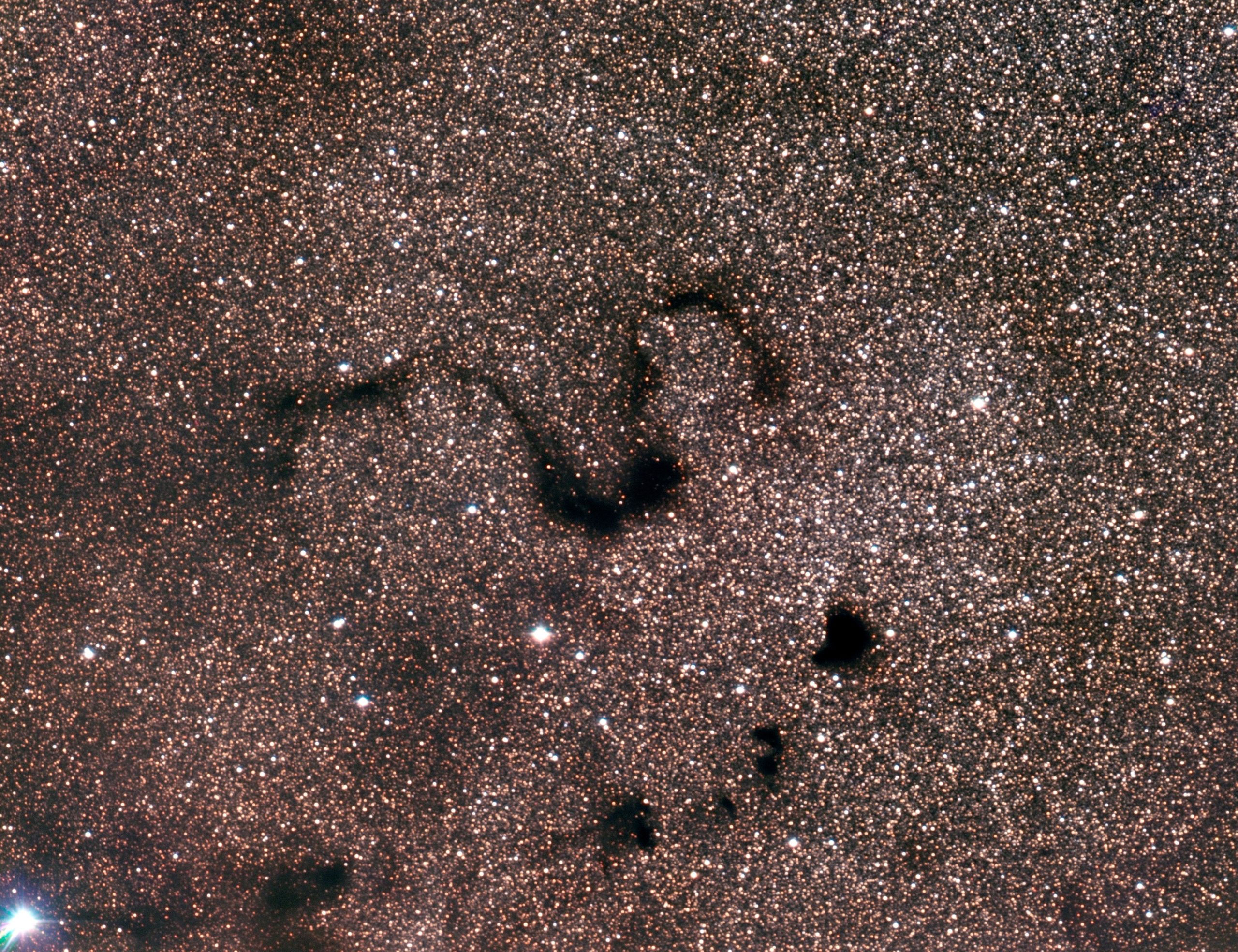
By Gary J. Becker, MD, former ABR Executive Director
Above is an image of B 72, the Snake Nebula (also known as Barnard 72, or the 72nd object in early 20th century astronomer Edward E. Barnhard’s catalogue of dark nebulae). I acquired the image data for this final post-processed image on the night of June 19th and the early morning of June 20th at my observatory in Benson, AZ, under remote control of my MacBook Pro here at my home in Tucson, 55 miles to the WNW of the observatory.
The Snake Nebula is a dark nebula. Remember these other types of nebulae: emission nebulae and reflection nebulae. In contrast to the latter two, dark nebulae do not emit or reflect light. Instead, they block light from reaching us. They are very dense collections of extremely cold gas and interstellar dust having temperatures not much warmer than absolute zero. A typical temperature might be 10oK (-263oC, -441oF). The cold gas is so dense that it is common for regions within such collections to collapse under the force of their own gravity and thereby give rise to star formation.
So what light is being obscured by B 72, the Snake Nebula? The light of a rich star field that can be found in our own Milky Way galaxy in the direction of the constellation Ophiuchus (The Serpent Bearer). B 72 is a “mere” 650 light-years (more than 3.8 quadrillion miles) distant from our solar system. At this distance, the Snake Nebula has been estimated to be 5 light-years (more than 29 trillion miles) from head to tail.
The very dark spot below and slightly to the right of the Snake Nebula is B 68, the Ink Spot nebula. Both the Snake and the Ink Spot are likely sites of future star formation. Other dark nebulae in the image are B 69, B70, and B 74. The brightest star (4.1 magnitude) in the image (lower left) is known as 44-Ophiuchi.
For the Techno-Geeks:
Paramount ME German equatorial mount
Celestron C14 telescope with Starizona Hyperstar (effective f/1.9)
QSI 683 CCD Camera
Focal length: 711 mm
Pixel size: 1.63 arcseconds per pixel
FOV: 90.5’ Width x 67.8’ Height
Astrodon filter set; each filter (Luminance, Red, Green, Blue) utilized separately
Total imaging acquisition time: 48 images x 300 sec per image: 4 hours
Binning: All L, R,G,and B images unbinned (1×1)
Microtouch Automatic Focusing motor
Autoguiding with Orion guidescope and Starlight Xpress Lodestar X2 camera
Planning Software: CCD Navigator, Megastar, ACP Planner
Remote access: Teamviewer and GoToMyPC
Acquisition software: TheSkyX Pro, Maxim-DL6, FocusMax 4, ACP Observatory Control
Image processing software: Pixinsight, Adobe Photoshop & Adobe Lightroom 2020
RA Center: 17h 23m 30s
Dec: -23o:38’:00”