Continuing Certification Update: OLA Is A-OK With VA Physician
By ABR Associate Director of Communications Rodney Campbell
April 2026;19(2):11
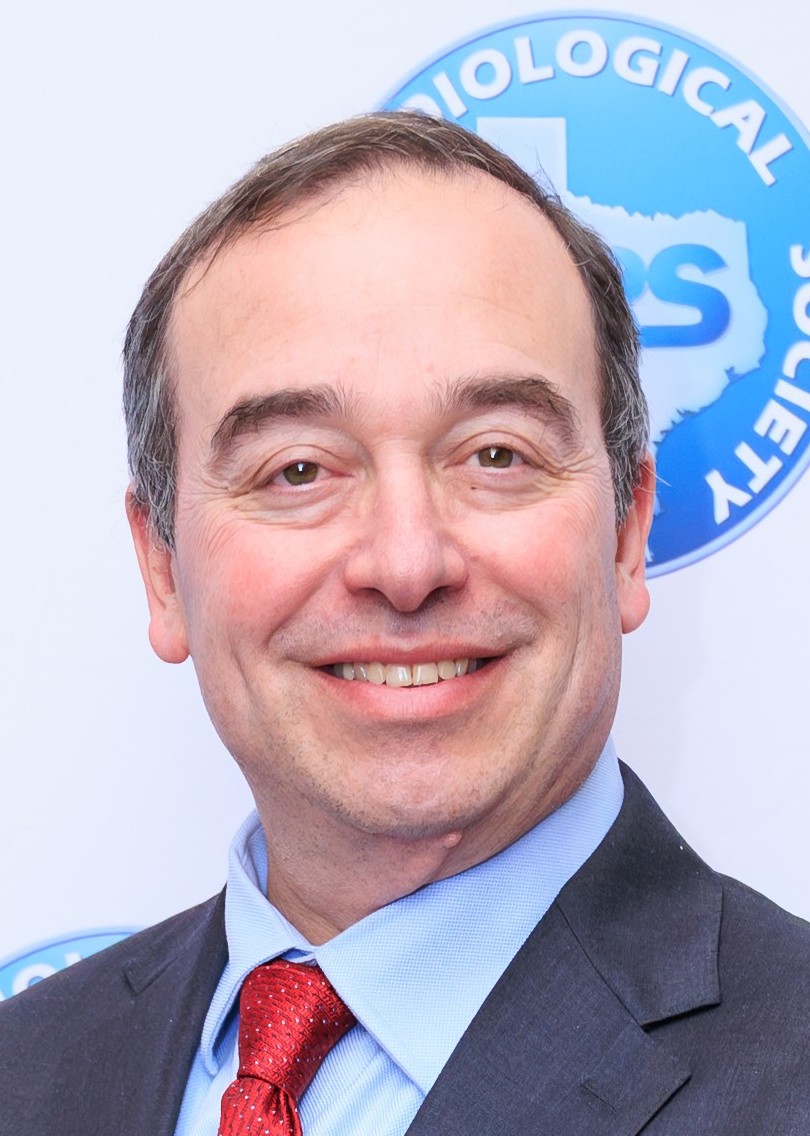
When Michel Courtines, MD, attended the Texas Radiological Society annual meeting in February, he did something he often does. He visited the ABR booth.
“I make a habit of stopping by to discuss what’s new with the ABR, see if there are any updates, changes in policy, new things being rolled out,” said Dr. Courtines, a physician with South Texas Veterans Healthcare Administration in San Antonio at the Audie Murphy VA Hospital. “I’m too busy during the regular year to keep track of what’s going on. Being at a meeting allows me the freedom to catch up and learn.”
Dr. Courtines went to the booth in Houston to express his appreciation for Online Longitudinal Assessment (OLA), the most convenient way to satisfy Part 3 of Continuing Certification.
He wanted to share his thoughts and those of his colleagues: They like the platform.
“I wanted to provide the ABR with user feedback,” he said. “Generally, a customer-service business or client-oriented operation tends to accumulate excessive negative feedback. You need to hear about it when you’re doing things right.”
He was intrigued when the ABR introduced OLA for diagnostic radiologists in 2019. He and his peers appreciated having an option other than passing an exam every 10 years (now every five years) to maintain their certification.
“I was excited because I thought it was going to accomplish two things,” Dr. Courtines said. “OLA would decrease the stress and the study burden of a massive exam, but at the same time, actually improve learning and knowledge because it’s continuous.”
Dr. Courtines has plenty of experience with board certification, having passed certifying exams hosted by the American Board of Internal Medicine in 2001, American Board of Nuclear Medicine in 2007, and ABR in 2013. Taking point-in-time exams is an experience he doesn’t want to repeat.
“It’s extremely stressful because the brain doesn’t get better with age,” he said. “(Radiologists) also tend to work more in certain areas and less in others. Having to relearn everything to pass a board exam like you’re 35 again is really challenging.”
Most OLA participants need to answer 52 questions a year to satisfy their annual progress requirement. How they get there is an individual choice. Some jump on the platform on Monday mornings and take care of their two weekly questions right away.
With his busy schedule, Dr. Courtines often answers his questions in batches of eight. He also stops every year once he reaches his annual progress requirement. Others answer every question opportunity they’re given.
“The flexibility is outstanding,” he said. “That has not been an issue. Speaking with my colleagues, everyone loves how it is now. We’ve gotten used to the system and we really like it.”
While OLA questions are considered walking-around knowledge and shouldn’t require studying, participants occasionally get them wrong. That’s where the education element kicks in.
“You have to know your stuff to get the questions right,” Dr. Courtines said. “It also validates your knowledge base, meaning when you’re missing stuff, you need to study those areas. When you’re getting things right, it gives you confidence that you are well-trained and that you’re able to take care of patients to the best of your ability.”
Whether he’s getting questions right or wrong, Dr. Courtines said OLA is a learning tool. Although he doesn’t share platform content, he said the questions help him and his peers stay current while working with residents. He serves as adjunct faculty at UT Health San Antonio and teaches residents at San Antonio Military Medical Center.
“It informs us and helps us teach the next generation of residents by keeping us focused on what’s relevant today and what they’re expected to know,” he said.
Knowing that OLA content is created by his peers is especially satisfying for Dr. Courtines, who isn’t an ABR volunteer. He appreciates the fact that physicians and physicists are so dedicated to their professions that they make the time to volunteer for their medical specialty board and create questions that are relevant to everyday practice.
“It’s a labor of love,” he said. “They’re doing a great job and making a difference every day.”