Volunteer Spotlight – DR: He Welcomes AI’s Positive Effects on Radiology
By ABR Communications Manager Rodney Campbell
December 2025;18(6):8
A concern about the rise of AI in diagnostic radiology is that the technology will eventually make some physicians’ jobs obsolete.
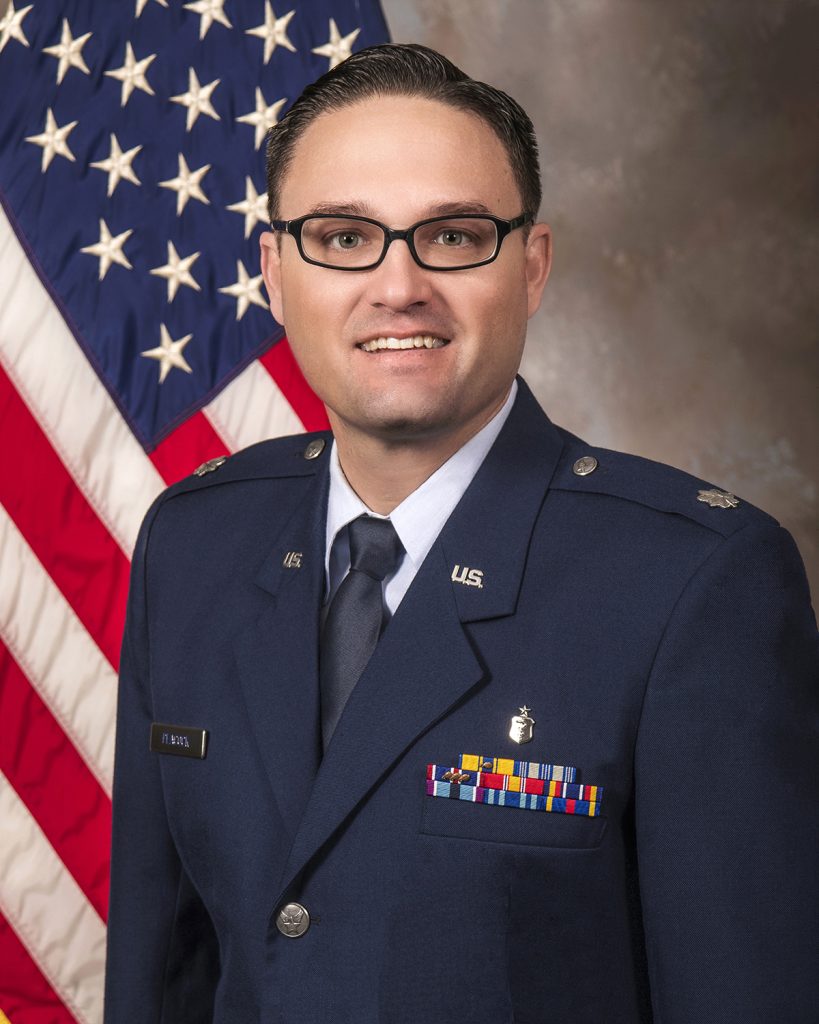
Justin Peacock, MD, doesn’t share that gloomy outlook.
“When I talk to faculty and give courses on how AI can help them, I always say, ‘AI won’t replace you per se, but it will replace individuals who don’t learn how to use the tool effectively to be a better physician,’” he said.
Dr. Peacock, an ABR volunteer who writes questions for the Diagnostic Radiology (DR) Certifying Exam and DR Nuclear Radiology Subspecialty Exam, is an associate dean for research and assistant professor at a military health sciences university in Maryland.
Currently pursuing a master’s degree in health professions education, he said AI helps him work better with trainees and colleagues.
“I’m a big AI enthusiast in terms of how we use it to improve education,” said Dr. Peacock, who graduated from the Mayo Clinic Alix School of Medicine and did his residency and fellowship with the military. “I develop curriculum for faculty and students on how to use AI to either teach or learn better.”
He believes the technology is a complementary tool, both in and out of the clinic.
“I think what it is very good at doing is narrow tasks like measuring a nodule or giving a differential diagnosis or detecting a lesion that might be a breast cancer,” he said. “It’s very good at reviewing reports or correcting errors.”
He says AI isn’t perfect, and there are tasks for which it will need time to develop solutions.
“What it’s not good at doing, and I’m not sure if we’ll get there, is putting the whole picture together, especially on complex exams like I do in nuclear medicine,” Dr. Peacock said. “PET CT is a complex exam with both anatomy and physiology going on, and then you need to put a complete picture together of what’s happening with the patient based on all the individual findings.”
Dr. Peacock believes there will always be processes that require physician involvement, especially when working with patients.
“There are recommendations of what would logically be the next thing that we would want to do,” he said. “I think all of that is still not well captured by AI tools, and I don’t think it will be for a while. That’s where humans need to be involved.”
Dr. Peacock doesn’t employ AI when he writes ABR exam questions; the organization’s policies disallow its use. Instead, he relies on real-life experiences to measure examinee knowledge and competence.
“When I’m going through cases in the reading room, I’ll highlight or capture certain ones that I think are really high-quality examples of imaging,” he said.
After starting as a question writer for the ABR’s Online Longitudinal Assessment platform, Dr. Peacock moved on to creating content for Initial Certification exams. He enjoys the challenge, having developed relevant questions for his trainees before he became an ABR volunteer.
“What I always try to do is get people to not just have a quick recall but try to integrate concepts that might be interrelated or get to a higher-level order of thinking and learning where they’re combining this principle and that principle,” he said. “That’s what I like doing. It’s a nice creative outlet. It’s the way our education should be focused, not just on quick fact memorization.”