Radiation Oncologist Fulfilling His Middle-School Dream
When he was in the eighth grade, John Fiveash, MD, knew he wanted to pursue a career in medicine.
His plans were next level for a middle schooler.
“I thought as an eighth grader that I might starve if I was a laboratory researcher,” Dr. Fiveash said. “I was worried about that. So I decided that I wanted to be a physician.”
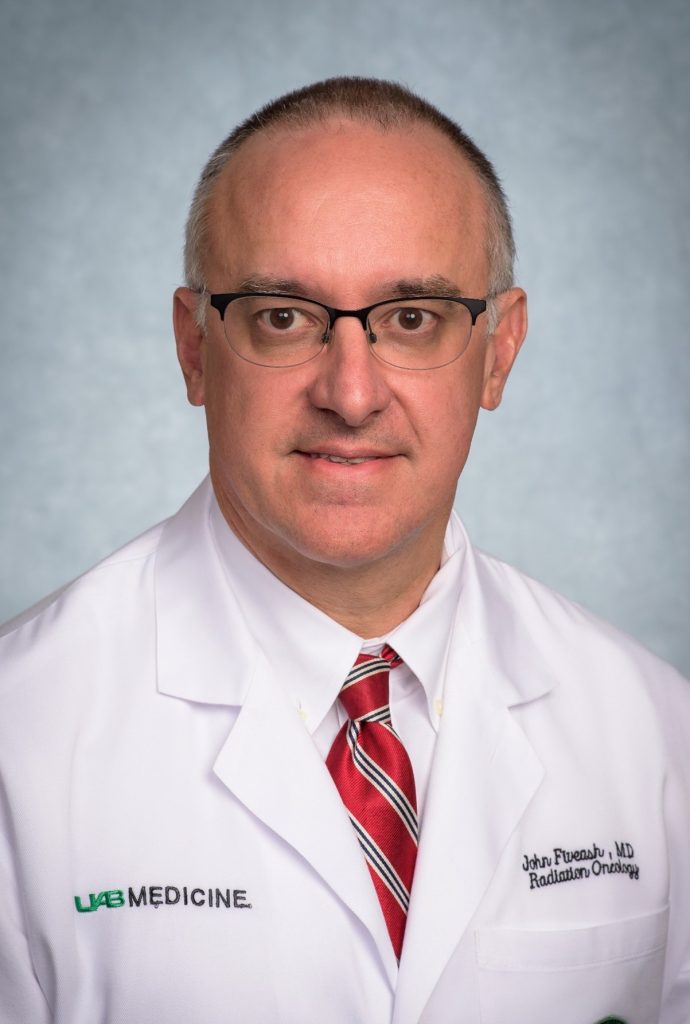
Inspired by an uncle who practiced radiation oncology (RO), Dr. Fiveash chose that path, becoming a central nervous system radiation oncologist who treats primary and secondary brain tumors.
“My research has been in both,” he said. “I’ve seen a lot of changes in the way we do radiosurgery and the number of tumors that we treat.”
At UAB Medicine, he divides his time between treating patients, clinical research administration, and scientific peer review duties after serving as a residency program director and vice chair for academic programs.
Radiation oncology offers multiple entry points to physicians who are drawn to the field for different reasons. For Dr. Fiveash, clinical work provides an opportunity to help patients and their loved ones.
“You can be a math person and come at it from the computer and programming side,” Dr. Fiveash said. “You can be a biology person and come at it from the cancer biology side of things, or you can be a person who wants to get to know their patients better and help them face a very difficult time in their lives and develop relationships.”
Those relationships sometimes include delivering terrible news when treatment options are no longer viable. On those occasions, physicians do what they can to make a patient’s remaining time as comfortable as possible.
“Sometimes you’re in a situation where you’re not going to be able to help the patient live much longer,” Dr. Fiveash said. “The question is, how do you deal with that psychologically? My advice is you take the win when it presents itself. Maybe you helped make the patient’s pain better so he can go to his grandson’s graduation or helped a family understand what’s going to happen in the next few months.”
Families don’t forget when a physician treats their loved ones and them with kindness and respect. Dr. Fiveash sees the results when he’s out and about in his Birmingham, Alabama, community.
“I’ll be walking through Costco and a family member will come up and say, ‘Hey, I bet you don’t remember me, but I was so-and-so’s son. You really helped us out,’” he said. “There’s a lot of job satisfaction from knowing that you can help somebody.”
Dr. Fiveash became an ABR volunteer as a residency program director at UAB, joining the question-writing committee for the RO Oral Certifying Exam. Working with the organization gave him an insider’s knowledge about the Initial Certification (IC) process.
“I was very involved in education in our residency program at the time, and I saw it as an opportunity to learn more about the ABR and the credentialing exams,” he said.
Being a part of the committee gives Dr. Fiveash the chance to learn from other notable people in the field. The conversations that members have in and out of meeting rooms are educational, even to physicians who are experienced in their fields.
Dr. Fiveash earned board certification in 1998 after getting his medical degree and completing a residency at Medical College of Georgia and finishing a fellowship at the University of Michigan Hospitals & Health Centers.
“There are a number of people I might not have a chance to interact with very often who serve on that committee,” he said. “Despite me being an organ site expert, I learn things from their questions and the discussion.”
ABR IC exams are a group effort. Each question goes through multiple reviews to ensure fairness and relevancy.
Learning to write good questions takes time, often at least a year for volunteers. Dr. Fiveash has done it long enough to know, and he appreciates every ABR exam’s goal: ensuring patient safety.
“I had to learn a lot about the testing evaluation,” he said. “Does this (qualify as an appropriate question) or is it just about a very specific number from one trial? Are we asking a question that tests whether the examinee knows how to take care of a patient? We go through questions as a group and ask, ‘Is this something that’s going to test whether the person knows how to take care of a patient?’ That fundamentally is what I fall back on.”