


Salt and Pepper Star Cluster M 37
-
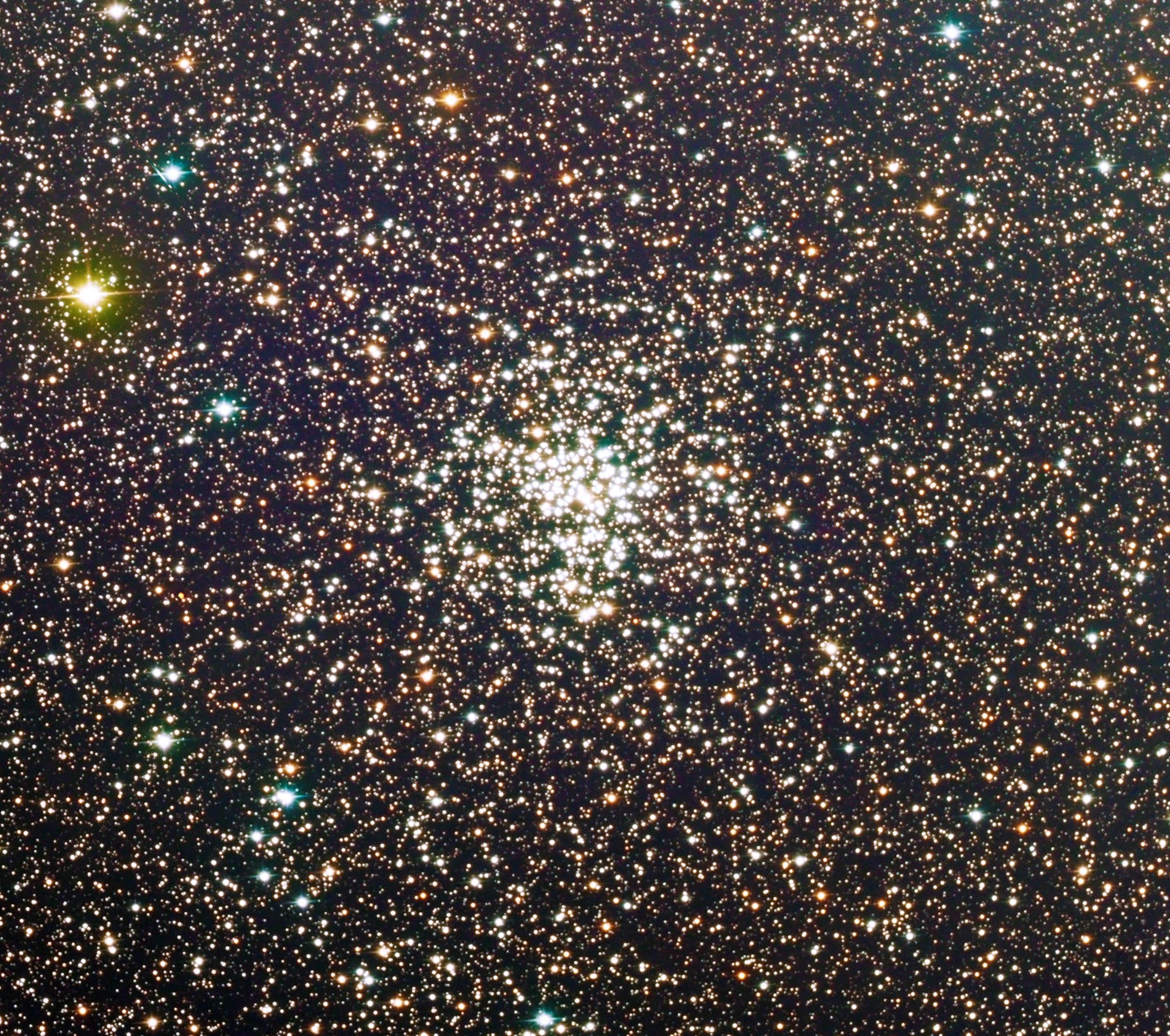
By Gary J. Becker, MD, former ABR Executive Director
Time for another pic from outer space.
I acquired the image data in the attached image at my observatory in Benson, AZ, during the early evening hours of March 6 and March 15, 2018, with use of remote observatory control software on my MacBook Pro here at home in Tucson. The first and most striking feature of the image is simply the richness of the star field. It is so rich because, as we search for our object of interest in the direction of the constellation Auriga, we find that Auriga overlies a band of the Milky Way.
The next image feature, the main object of interest, is the roughly triangular cluster of blue-white Type A stars (7,600 to 11,000 degrees Kelvin) at the image’s center. (Spica and Rigel are two prominent stars in our night sky that are of the same type.). The cluster, which contains more than 500 identified stars ranging in age from about 350 million to 550 million years and having a combined mass of about 1,500 suns, is found in the direction of Auriga in the winter and early spring night skies of the northern hemisphere at a distance of approximately 4,500 light-years (26.5 quadrillion miles) from Earth.
M 37 belongs to a class of objects known as open star clusters. We’ve looked at some globular clusters in the past and will see some more in the future. However, open clusters differ from them entirely in origin and structure. An open cluster is a group of up to a few thousand stars that share a common origin, in that they were formed from the same giant molecular cloud. They are also loosely gravitationally bound to each other. While the molecular cloud responsible for M 37 is long gone, often we observe open clusters as components of the most iconic gaseous nebulas that still have active star-forming regions. The Orion Nebula and the Eagle Nebula are two good examples. In these examples and others, powerful UV radiation from the star cluster shapes the gas cloud, ionizes the gas, and is thus responsible for the light that is emitted from the gaseous cloud. Over many millions of years, as an open star cluster forms, the radiation pressure from the young energetic stars literally pushes the molecular cloud away. This tends to happen when about 10% of the molecular cloud has been consumed in star formation. One of the most easily-observed and well-recognized open clusters in the night sky is The Pleiades (Seven Sisters), M45, which can be seen with the naked eye or binoculars.
For the techno-geeks:
Celestron CPC 1100 telescope fork-mounted with wedge onto a pier and polar-aligned for simple equatorial mount.
Hyperstar Optics
QSI 683 CCD Camera,
F 2.0
Focal length: 561mm
Pixel size: 1.99” per pixel
FOV: 110.5’ x 82.9’
Astrodon filter set; each filter (Luminance, Red, Green, Blue) utilized separately; total imaging acquisition time: 165 minutes; all images unbinned; individual frames each 300 sec
Microtouch Automatic Focusing motor
Starlight Express Lodestar X-2 Autoguider
Acquisition Software: TheSkyX Pro, Maxim-DL6, FocusMax 4, ACP Observatory Control and ACP Planner, Megastar
Image Processing Software: Pixinsight and Adobe Photoshop CC 2017