Volunteer Spotlight – MP: He Made the Quantum Leap to Medical Physics
By ABR Associate Director of Communications Rodney Campbell
August 2026;19(4):10
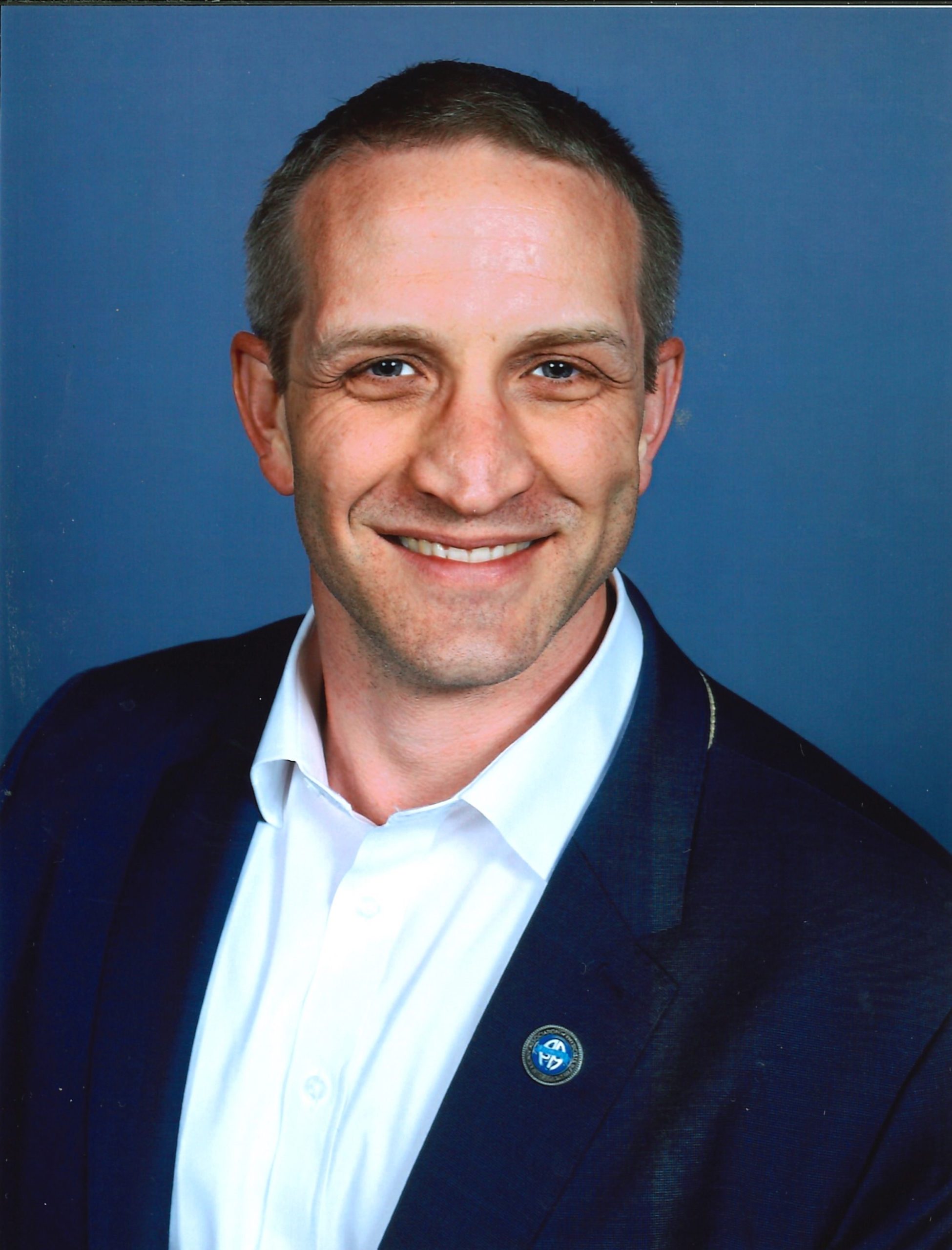
With a bachelor’s degree in physics from Utah Valley University almost in hand, Samuel Brady, MS, PhD, had his career path planned.
“I was a physicist straight up,” he said. “For a long time, I was interested in quantum physics. I was planning for a career at CERN (the European Laboratory for Particle Physics). I wanted to just do theoretical physics.”
A conversation with a mentor changed his mind. The instructor pulled Dr. Brady into his office and showed him a research paper he had recently published. What the young physics student saw was eye opening.
“He flipped five pages into it and pointed at something,” Dr. Brady said. “I leaned in and said, ‘What is that?’ It was his name. He was one of 1,000 physicists who published this one paper and he said, ‘Physics is wonderful, but if you go into it, you’ll forever be known as et al.’”
Dr. Brady’s desire to perform research with more clinical application made him lean toward biophysics when applying for graduate school. But there was one problem: His portfolio was heavy on physics and light on biology.
He Googled “biophysics career paths” and discovered medical physics. He made what he soon thought was a mistake, when he applied for and was accepted into the medical physics master’s program at Duke University.
“On the first day of class, I was listening to instructors talking about CT scanners and LINACs for therapy,” he said. “I was thinking, ‘I don’t know what any of these things are let alone look like. What have I gotten myself into?’”
After gaining a better grasp on the field, Dr. Brady earned his master’s and doctorate in medical physics at Duke. Now the division director and clinical medical physicist at Cincinnati Children’s Hospital and professor of radiology at University of Cincinnati, he’s seeing results from his change of heart.
“(Getting into medical physics) was the best mistake I ever made,” he said. “It straddles the line of medicine, biology, and physics. Almost all the papers I write as a scientist find their way directly into clinical care; I love the impact I can make on the clinic in real time. I would’ve been very proud to be a theoretical physicist, but I might have died before any of my theories ever changed anything.”
Dr. Brady has been focused on pediatric radiology his whole career. He came to Cincinnati from St. Jude’s Children’s Research Hospital. He found the work there rewarding and struggled with the idea of leaving. But he saw his current employer as an avenue to extend his skills and reach.
“St. Jude’s is amazing and wonderful,” he said. “But it’s very focused on cancer. Cincinnati Children’s is more general. We do everything for cardiology, oncology, every ‘ology’ that you deal with. Making the move helped me become a well-rounded clinical physicist and has given me the opportunity to make a broader impact on pediatric radiology as a whole.”
He helps the ABR and his field by serving as a volunteer question writer and oral examiner. At the end of the year, he’ll wrap his second term as chair of the committee that writes medical physics questions for the ABR’s Diagnostic Radiology Qualifying (Core) Exam.
Running that committee and determining appropriate content is a challenge. He works with and writes questions for physician candidates, not people who are training in his discipline.
“Teaching radiology residents and volunteering with the ABR to write physics exam questions for radiologists has made me a better physicist. To know physics, we take high-level math and physics classes,” Dr. Brady said. “But (serving on the committee) challenges me to be able to distill these complex concepts into a language that radiologists who didn’t go to school as physicists can understand.”
Getting the right committee members is crucial to crafting appropriate questions for third-year residents. As the chair, Dr. Brady sticks by one rule.
“One of the requirements I’ve always had is I need physicists who teach residents,” he said. “I say that because they are practiced and have honed in the ability to think at that level. Our ultimate goal when preparing the physics content for the Core Exam is to create clinically relevant physics questions.”
Dr. Brady connected with now-former ABR Trustee Kalpana Kanal, PhD, before he became a volunteer. The two also give their time to the American Association for Medical Physics (AAPM) and once traveled to Thailand as part of a group on an International Atomic Energy Agency mission.
“I met Sam when he came up to me at AAPM and told me that I had been one of his oral examiners, and how much he appreciated my kindness and patience during his exam,” Dr. Kanal said. “I was immediately impressed by Sam’s intelligence and demeanor, and over time, I began treating him as a mentee, helping to involve him in ABR and other AAPM opportunities. Sam has grown into a wonderful leader.”