Hockey is a Cool Way for Medical Physicist to Stay Active
One of the ways that medical physicist Justin Zenn relaxes away from work is mixing it up in a local hockey league a couple of times a week in Fishers, Indiana, near Indianapolis.
Every January, he takes it to the extreme and participates in the U.S. Pond Hockey Championships, an outdoor event. This year’s tournament was held on Lake Nokomis in Minneapolis, and the weather was particularly rough thanks to Winter Storm Fern.
“It was really cold this year,” Justin said. “Our first day, it was negative 17 with a negative 35 windchill. They cancelled most of the stuff that day and moved it to the following day. The next day we really didn’t have much wind, and it was about negative 13, but it felt drastically better.”
This was the fourth time that Zenn and his team competed in the event. His male and female teammates, all in their 40s, are friends who also play locally in Indiana. They call themselves Mid-ice Crisis.
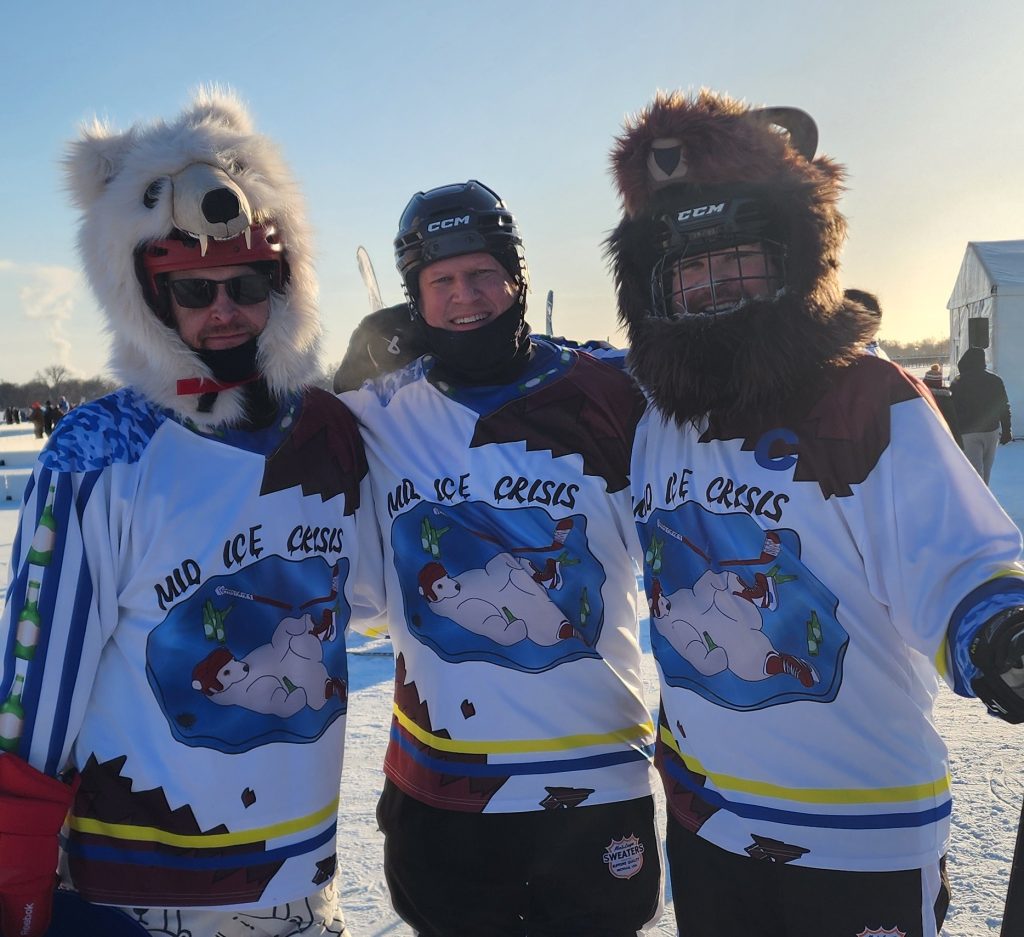
The team usually plays between four and six games at the event. This year, the frigid temperatures held them to three. Regardless of how often they play, the setup is the same. Competitors use shovels to fill cracks in the ice to ensure that the surface is safe. The boards around the rink are two feet high and the goals are wood and eight inches tall. Pond hockey is a lot like a childhood neighborhood game.
“It’s just like when you were a kid … throw some light gear on and start playing hockey,” Justin said.
Pond hockey and recreation league games have their challenges. Play can get rough. Justin often serves as goalie and gets pelted by hard-hit shots.
“I sometimes come home with massive bruises all over my body from blocking pucks,” said Justin, who played catcher on his college baseball team at Cedarville University. “But I’ve just always enjoyed the physicality of it and the competition.”
Justin has a bachelor’s in mechanical engineering from Indiana University-Purdue University Indianapolis and a master’s in health physics from Purdue University. In his professional life, Justin has been a diagnostic imaging physicist at Medical Physics Consultants, Inc. (MPC), since 2004. He’s responsible for clients across Indiana and a few in Illinois, Kentucky, and Ohio. He specializes in performance testing of CT, MRI, mammography, ultrasound, cardiac cath labs, and radiographic and fluoroscopic systems.
“I would never want to do anything else in life,” he said.
Justin became an ABR volunteer after encouragement from Jim Carey, his boss and president of his company. Jim also worked with Justin’s dad, Duane, at MPC.
“He has a friendly demeanor and an amazing work ethic that helps MPC land and keep our family of accounts,” Jim said of Justin. “He has an amazing understanding of all the diagnostic imaging modalities and vast experience with a multitude of imaging systems from various vendors. He is a valuable, talented resource for the ACR and a great teacher who is willing to share his knowledge and experience with his fellow physicists.”
A member of the American College of Radiology and the American Association of Physicists in Medicine, he was surprised to find another way to serve his specialty.
“It’s something I would’ve never seen,” he said. “I just wanted to work. I enjoy my job. I enjoy what I do. I had no idea that this was another way to give back and be part of the greater physics community.”
Justin has worked his way up to become chair of the MP Part 1 Exam Question Writing Committee this year. He was unsure what to expect when he started on the committee in 2020.
“When I saw the people on the committee, I was nervous,” he said. “I thought they were all smarter than me. I didn’t know that I belonged there. But they were such a great group of people. They were so welcoming and I found my spot.”
When Justin talks about his hockey team, he sounds like he’s describing the typical ABR volunteer experience. Committees are made up of teammates from across practice types and varied backgrounds. They work together to achieve success.
“I’ve met all kinds of people that I probably never would’ve been friends with,” he said of playing hockey. “The community is like anything else. Playing with so many great people is what I’ve enjoyed the most.”