About the ABR
Learn what the ABR does and why board certification matters — for patients, physicians, and medical physicists, and the future of healthcare. Visit our Leadership and Governance page to learn more about our Boards and review our Bylaws.
-

At the American Board of Radiology (ABR), our mission is to certify that our diplomates demonstrate the requisite knowledge, skill, and understanding of their disciplines to the benefit of patients. Our vision is to positively impact the lives of all patients as the foremost trusted certifying body assuring the highest standards of specialty expertise and professionalism in the radiological sciences.
On this page, you’ll learn how board certification supports better health care for everyone, who we are, what we do, and our history.
Why Board Certification Matters
When it comes to health, everyone deserves care from professionals who meet the highest standards. Board certification means your physician or medical physicist has completed rigorous training, has demonstrated expertise, and stays up to date with the latest advancements in their field.
For patients and medical professionals, board certification reflects:
- Trusted expertise.
- Continuous learning.
- Compassionate, patient-centered care.
- A commitment to quality and professionalism.
Whether you’re seeking care or delivering it, board certification makes a difference.
Who We Are
The ABR is an independent, not-for-profit organization that’s been setting the benchmark for excellence in the radiologic sciences since 1934. As one of 24 Member Boards of the American Board of Medical Specialties (ABMS), we work to make sure that certification isn’t just a one-time milestone — it’s a lifelong commitment to learning, growth, and delivering better care for patients.
ABR-certified volunteers lead the ABR with expertise, vision, and a commitment to patient care. Through collaboration, our leadership responds to the evolving needs of the radiology and medical physics communities. Visit our Leadership and Governance page to learn more.
Our Strategic Priorities
The ABR Board of Governors (BOG) identified ten strategic priorities to guide our work with you—our candidates, diplomates, volunteers, the public, and professional partners. These priorities reflect our commitment to meaningful, sustainable certification and align the BOG’s oversight with staff and volunteer activities.
Our priorities are to:
- Control costs
- Improve communication
- Create/maintain balance in our certification processes
- Maintain the highest standards in our assessment processes
- Enhance service
- Reduce risk
- Enhance volunteer experience/engagement/value
- Take care of our staff
- Proactively collaborate with our professional organizations
- Create a culture of improvement and innovation
These priorities often overlap; a single initiative may address several at once. Together, they help us strengthen certification, support the professions we serve, and continually improve how we work with you.
What We Do
We support that work by:
- Certifying that physicians and medical physicists meet rigorous educational and professional standards.
- Creating fair, flexible pathways to help professionals stay current in rapidly evolving fields.
- Collaborating with healthcare leaders to continuously improve how we assess and support medical professionals.
- Making it easy for the public to understand who’s board certified and what that means for patient care.
Commitment to Transparency
We’re proud to have earned Candid GuideStar’s Platinum status since 2017, the highest level of recognition for nonprofit accountability. We aim to uphold this standard every year through independent audits and publicly available financial statements, including the ABR Form 990. Please also see our Foundation Form 990 and Form 1023.
View our Candid GuideStar profile.
Our History
The ABR was founded in 1934 by leading radiology societies to create a formal process for certifying specialists in radiology. Over the decades, we’ve evolved alongside the field, adapting to technology, education, and clinical practice advancements.
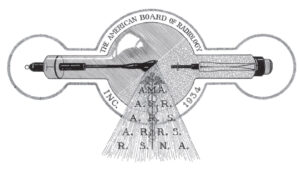
First ABR Logo From beginnings in Washington, D.C., to our present-day operations headquartered in Tucson, Arizona, key milestones of our journey include:
- 1980: Moved from general radiology to diagnostic radiology and radiation oncology certificates.
- 1994: Began issuing subspecialty certificates in nuclear radiology, neuroradiology, pediatric radiology, and vascular and interventional radiology.
- 2002: Began issuing non-lifetime certificates for all disciplines.
- 2017: Moved from vascular and interventional radiology subspecialty certificates to interventional radiology/diagnostic radiology specialty certificates.
- 2019: Launched online longitudinal assessment (OLA).
- 2021: Started administering all exams remotely.
Our Certificates and Specialties
The ABR oversees the certification of the following specialties:
- Diagnostic radiology
- Interventional radiology/diagnostic radiology
- Radiation oncology
- Medical physics (diagnostic, nuclear, and therapeutic medical physics)
And the following subspecialties:
- Neuroradiology (available to diplomates with certification in DR or IR/DR)
- Pediatric radiology (available to diplomates with certification in DR or IR/DR)
- Nuclear radiology (available to diplomates with certification in DR or IR/DR)
- Pain medicine (available to diplomates with certification in DR, IR/DR, or RO)
About Our Certificates
ABR certificates can be either:
- Continuous: requires ongoing participation in Continuing Certification.
- Lifetime: does not require participation in Continuing Certification to remain valid.
Over the years, we’ve updated the names of some certificates to reflect changes in the field. Older certificates under previous names remain valid, and diplomates holding them are still eligible to maintain their certification.
If you’re unsure about the status or name of your certificate or just want to find more information about legacy certificates, name changes, and more, contact the ABR.
ABMS Scholars Program™
The ABR partners with the American Board of Medical Specialties to assist candidates and early career diplomates with research efforts and leadership development through the Scholars program.
A one-year, part-time program, ABMS Scholars* facilitates research projects that address pressing health care issues and research priorities for the Member Board community. The ABR is one of 24 ABMS Member Boards.
The ABR became involved in the program in 2022, choosing Cleveland Clinic physician Sara Hunter, MD, as the first recipient. Our goal is to fund up to four projects each year, covering diagnostic radiology, interventional radiology, medical physics, and radiation oncology professionals.
You can find more information about the program on the ABMS’ website and in this video.
*The program was originally called “ABMS Visiting Scholars.”
2025-’26 Scholars

Abdullah Alshreef, PhD, MS, MSc; Joseph Lee, MD; Oluwatimileyin Ojo, MD The ABR is sponsoring three Scholars in this year’s cohort:
Abdullah Alshreef, PhD, MS, MSc, is the first medical physicist to be chosen for the program. A resident at Loma Linda University Medical Center, his research project is titled: “Enhancing Clinical Readiness and Board Exam Preparation through Virtual Education Resources for Medical Physics.”
Joseph Lee, MD is a diagnostic radiology fellow at Virginia Commonwealth University Health System. His research project is titled: “Agentic AI Platform to Enhance Radiology Oral Board Preparation and Certification Readiness.”
Oluwatimileyin Ojo, MD is a radiation oncology resident at Northwell Health Cancer Institute. Her research project is titled: “Evaluating and Enhancing Systemic Therapy Education in Radiation Oncology Residency Programs.”
2023-’24 Scholars
This year’s class of Visiting Scholars includes one diagnostic radiology assistant professor and two radiation oncology residents who are sponsored by the ABR.

Francis Deng, MD; Leslie Chang, MD; and Ria Mulherkar, MD Francis Deng, MD (diagnostic radiology), Leslie Chang, MD (radiation oncology), and Ria Mulherkar, MD (radiation oncology), were selected from a group of applicants.
Dr. Deng is an assistant professor of radiology and radiological science at Johns Hopkins School of Medicine, Dr. Chang is a resident at Johns Hopkins, and Dr. Mulherkar is a resident at the University of Pittsburgh Medical Center Hillman Cancer Center.
2022-’23 Scholar
Our first Visiting Scholar was Sara Hunter, MD, a diagnostic radiologist at the Cleveland Clinic. Her project, titled, “It’s Not Enough to be Up-to-Date, You Have to be Up-to-Tomorrow: How Longitudinal Assessment Encourages Radiologists to Stay Current,” examined the impact of Continuing Certification programs, like Online Longitudinal Assessment.