Initial Certification
Last verified on July 29, 2024
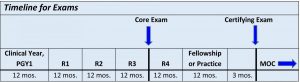
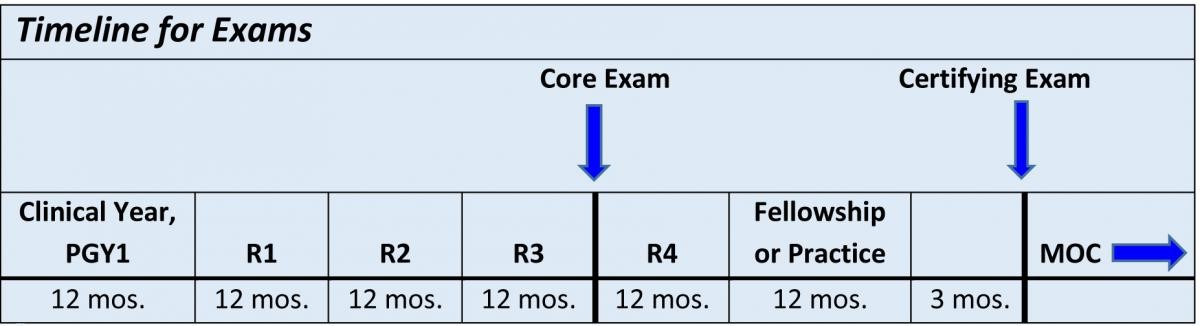
As candidates progress through their residency and after completion of training, they will take two exams to gain initial certification in diagnostic radiology: the Qualifying (Core) Exam and the Certifying Exam.
The Exams
The
Qualifying (Core) Exam, offered after 36 months of residency training, is image rich and computer based; it covers 16 subspecialty and modality categories.
The
Certifying Exam, given approximately 15 months after completion of diagnostic residency training, is also computer based and image rich, and it includes four modules. Three modules are clinical practice areas and may be chosen by the examinee to fit his or her interests, experience, and training. The other module, Essentials of Diagnostic Radiology, is taken by all examinees.
Please see the
Diagnostic Radiology Calendar for future exam dates.
Transition to Remote DR Oral Certifying Exam
Beginning in calendar year 2028 and first applying to DR residents completing training in June 2027 (entering their R1 year in July 2023), the certifying exam for DR will be the new DR Oral Exam. From that point on, a candidate’s first opportunity to take the new DR Oral Exam will be the calendar year following completion of their DR residency. All DR candidates taking the DR Certifying Exam after 2027 will be required to take the new DR Oral Exam regardless of when they completed residency training. We anticipate having two exam administrations per year. For more information and updates pertaining to the new DR Oral exam, please visit the
New Diagnostic Radiology Oral Exam page.
More Information
The ABR offers two
Alternate Pathways to certification in diagnostic radiology.
Information is also available for
Program Administration (Program Directors and Program Coordinators) and
Credentialers and Practices.
See our
Certificate FAQs.
For those who have completed residency and are seeking employment:
The ABR provides a letter clarifying the mandatory waiting period before certification may be earned. A resident may provide this letter with his or her application materials to a potential employer.
Click here for a copy of the letter.
Recognition of Successful Candidates
Successful ABR Candidates are awarded a continuous ABR specialty certificate in diagnostic radiology.
Continuing Certification (MOC)
Continuing certification in diagnostic radiology is contingent upon meeting the requirements of the ABR’s Continuing Certification (MOC) program. For Continuing Certification (MOC) program details, please see the
Continuing Certification page.
For questions related to these or other board certification issues, please contact us at
information@theabr.org or
520-790-2900.
 Please see the Diagnostic Radiology Calendar for future exam dates.