Get Certified in Diagnostic Radiology (DR)
Learn the steps to becoming ABR board certified in diagnostic radiology, including eligibility requirements and the exam process. Visit our alternate pathways page to explore prerequisites, eligibility requirements, and other details for the diagnostic radiology alternate pathways.
-
-
Diagnostic radiologists use medical imaging techniques to diagnose and treat a wide range of medical conditions, including injuries, infections, tumors, and diseases.
The DR certification process ensures you have the knowledge and skills to provide high-quality patient care. You’ll need to meet specific education, training, and exam requirements to be eligible for certification.
Eligibility Requirements
1. Complete a year of clinical training
Before starting residency, you must complete a year of clinical training in a program accredited by the Accreditation Council for Graduate Medical Education (ACGME) or the Royal College of Physicians and Surgeons of Canada (RCPSC) in the U.S. or Canada. To learn more about ACGME clinical year training requirements, refer to the ACGME Diagnostic Radiology Program Requirements.
If you’ve completed accredited training in another specialty, you may be eligible for credit. This is reviewed on an individual basis after the appropriate documentation is submitted to the ABR.
If your clinical year includes a DR elective:
- It must be in a department with an ACGME-accredited DR residency program.
- It cannot be longer than two months.
- You can spend no more than a total of three months in radiation oncology and/or pathology.
If you’re in an RCPSC-accredited program, you’ll need a minimum of eight four-week blocks of clinical experiences outside of radiology.
2. Complete an accredited residency program or the International Medical Graduate Alternate Pathway
Complete a four-year ACGME- or RCPSC-accredited DR residency. It may include no more than 16 months of research.
Interested in research? Learn more about the Holman Research Pathway for an alternate option.
3. Pass your exams
- Qualifying (Core) Exam – Taken after 36 months of residency. In limited circumstances, your program director or, if you are in the IMG Alternate Pathway, your program chair, can request permission for you to take the exam earlier.
- Certifying Exam (2026 & 2027) – After passing the Qualifying (Core) Exam and at least 12 months after you complete your residency, you can take the computer-based Certifying Exam. If you are in the IMG Alternate Pathway, you are eligible for the Certifying Exam any time after the fourth year of training. You do not have to wait until the following calendar year.
- Oral Exam (After 2027) – After passing the Qualifying (Core) Exam, you can take the Oral Exam. Please see the Exam Timing chart here.
4. Hold a valid state or provincial medical license
If you’re still in training, a valid training license is acceptable.
5. Demonstrate ethical standards
The ABR expects all candidates to uphold fundamental moral and ethical principles and exhibit professional behavior throughout the certification process.
Special Training and Fellowship Credit
Fellowship credit toward residency
If you completed an ACGME-accredited radiology fellowship or an accredited nuclear medicine residency before your DR residency, you’re eligible for up to one year of credit (pending approval from your program director).
No more than one year can pass between the end of your fellowship and the beginning of your residency.
National Institutes of Health (NIH) Grant
If you’re training in an NIH R38-funded research program, you may be eligible for certification if you meet requirements equivalent to the Holman Research Pathway and all other certification requirements.
Board Eligibility
Board eligibility is the time from when you finish your training (accredited residency or Alternate Pathway training) to when you receive initial board certification. You have six full calendar years from residency completion to complete your DR certification.
To learn more, read our Board Eligibility Policy.
Residency Requirements and Policies
Residency Completion
Effective July 1, 2026, you must complete your four-year residency within eight years of your residency start date.
You’re expected to complete all four years of your residency within the same program. If you’re considering a transfer for any reason, your current and future program directors must approve the change. To support your transfer, you’ll need to provide a list of the rotations you’ve completed to the new program director, who will review that list and decide which rotations to accept.
To finalize the transfer, the ABR must receive a signed letter from both program directors confirming your start and end dates, whether you left your previous program in good standing, and which parts of your prior training will count toward your new program.
To learn more, read our Residency Completion Policy.
Taking Leave
Personal and family needs are important during residency. We support you in taking leave when you need it.
To learn more, read our Residency Leave Policy.
-
Apply for Certification
Once you begin your residency, your program director or coordinator will submit your name and email address to the ABR, so we’ll know you have officially started training.
As soon as we receive your information, we’ll send a welcome notification with instructions on how to log in to myABR and start your application. You’ll need:
- Medical school information
- Internship certificate (PDF copy)
- Residency start date
- Residency training dates by year
- ABNM certification, if applicable
You can submit your application between July 1 and October 31. The application fee is due when you apply. Applications are reviewed in the order they’re received.
-
Exam Process
Certification exams assess your knowledge, skills, and readiness for independent practice. The DR certification process includes two exams:
- Qualifying (Core)
- Certifying (2026 & 2027) or Oral (After 2027)
Qualifying (Core) Exam
This computer-based exam assesses your fundamental knowledge and clinical judgment across all key diagnostic radiology and integrated interventional radiology/diagnostic radiology areas. This includes anatomy, pathophysiology, diagnostic imaging, interventional procedures, and physics.
Exam Content
This exam covers a broad range of practice domains, including:
- Breast imaging
- Cardiovascular imaging
- Computed tomography
- Gastrointestinal imaging
- Genitourinary imaging
- Interventional radiology
- Magnetic resonance imaging
- Musculoskeletal radiology
- Neuroradiology
- Noninterpretive skills
- Nuclear radiology
- Pediatric radiology
- Physics
- Radiography/fluoroscopy
- Thoracic radiology
- Ultrasound
- Radioisotope Safety Content
Exam Format, Timing, Physics Integration, and Scoring
Format
This computer-based exam is administered remotely over three days and takes approximately five and a half hours per day. Explore exam formats in more depth, including a breakdown of how many questions are in each section, in the Qualifying (Core) Exam Guide.
Timing
The ABR offers the Qualifying (Core) Exam twice a year (typically in late May or early June and November).
Physics Integration
There’s no separate physics exam; physics questions are embedded throughout the exam. These questions reflect the fundamental medical physics commonly encountered by radiologists in interpreting images, executing procedures, and consulting with colleagues and staff.
Performance on physics-related questions is factored into the overall score.
Scoring
The Qualifying (Core) Exam is scored using a criterion-referenced scoring method. Your score is based on how well you do compared with a fixed standard — not how everyone else does.
The Qualifying (Core) Exam is scored as a whole, and the result is either pass or fail.
- You’ll pass the exam if your combined performance across all categories meets or exceeds the passing standard.
- If you don’t meet the standard, you must retake the entire exam.
Learn more about exam scoring.
Certifying Exam (2026 & 2027)
The Certifying Exam tests your ability to interpret imaging studies, develop differential diagnoses, and manage patient care.
Note: After 2027, candidates will be required to take the new DR Oral Exam rather than the computer-based Certifying Exam. Learn more about the new DR Oral Exam.
Exam Content
This computer-based exam is made up of four modules:
- Essentials of Diagnostic Radiology (Required Module)
This covers core knowledge every radiologist should have, such as recognizing child abuse, pneumothorax, and shock bowel.
It includes Noninterpretive Skills (NIS) topics that are important in radiology practice, like contrast reaction management, error prevention, communication, professionalism, and ethics.
- Clinical Practice Modules
You choose three modules from the following clinical practice areas to be tested on:
- Breast
- Cardiac
- Gastrointestinal
- General radiology
- Genitourinary
- Musculoskeletal
- Neuroradiology
- Nuclear
- Pediatric
- Thoracic
- Ultrasound
- Vascular and interventional radiology
All clinical categories have modules with two levels of difficulty — fundamental and advanced. If you take more than one module in a given category, content will be at the advanced level on the second (and third, if applicable) module.
For example, if you decide to be tested in general radiology for all three of your modules, your second and third modules will be more difficult than your first module. Each module will have the same core difficulty if you choose to be tested in three different practice areas, such as cardiac, nuclear, and pediatric.
Pediatric radiology and physics elements are integrated into all clinical modules, as is the second portion of the Radioisotope Safety Content, which focuses on real-world safety scenarios and regulatory compliance.
Exam Format, Timing, and Scoring
Format
This computer-based exam takes approximately seven and a half hours and is administered on one day. Explore exam formats in more depth, including a breakdown of how many questions are in each section, in the DR Certifying Exam Guide.
Timing
You can take the Certifying Exam 12 months after completing residency.
Scoring
The Certifying Exam is scored using a criterion-referenced scoring method. Your score is based on how well you do compared with a fixed standard — not how everyone else does.
The Certifying Exam is scored as a whole, and the result is either pass or fail.
- You’ll pass the exam if your combined performance across all categories meets or exceeds the passing standard.
- If you don’t meet the standard, you must retake the entire exam.
Learn more about exam scoring.
Oral Exam (After 2027)
Exam Content
The Oral Exam is an oral, case-based exam where you’ll discuss real clinical scenarios. The clinical categories are:
- Breast
- Cardiothoracic
- Abdominal (includes gastrointestinal, genitourinary, and ultrasound)
- Musculoskeletal
- Nuclear radiology
- Pediatrics
- Neuroradiology
Diagnostic radiology procedures, professionalism, and safety will be incorporated into the clinical categories as appropriate.
Exam Format, Timing, and Scoring
Format
Seven 25-minute oral exams covering the seven clinical categories are conducted one-on-one each with a different examiner. You can explore the exam format in more depth in the DR Remote Oral Exam Candidate Guide.
Timing
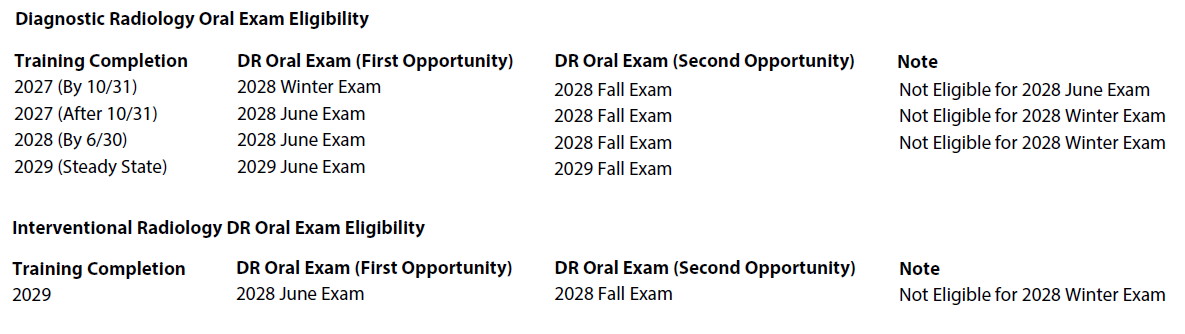
Scoring
The Oral Exam is scored using a criterion-referenced scoring method. Your score is based on how well you do compared to a fixed standard — not how everyone else does. The Oral Exam is scored by content category, and the result is pass, conditional pass, or fail.
- If you fail one or two categories, you’ll receive a conditional pass and you’ll only need to retake the portions you did not pass — not the entire exam. When you retake the exam, two examiners will re-evaluate you in each conditioned category. If both pass you, the condition will be removed.
- If you fail three or more categories, you’ll need to retake the entire exam.
-
Exam Registration
Once you’re eligible to take an exam, the ABR will send an email invitation three to four months before the exam date with instructions on completing registration in myABR.
To ensure you receive these emails, update your contact information, add @theabr.org to your approved senders list, and keep an eye on your spam folder.
Before registering for an exam, you’ll need to pay all exam fees.
If you miss an exam opportunity because you did not register, canceled your registration, or were otherwise unable to take the exam, and you’re still within your board eligibility period, you will be invited to the next available exam as outlined above. Please review the exam fees page for possible cancellation fees that may apply.
-
Exam Preparation
Experienced volunteers from all practice settings create ABR exams. We offer study guides and exam blueprints to help you prepare, but you’ll need to find the study materials that work for you. Keep in mind that materials from other organizations won’t always match the format, scope, or difficulty of ABR exams.
To learn more about how exams are created and scored, please see:
- Information for volunteers – how volunteers create exam questions
- Illustrated life cycle of an ABR exam item– a look at the extensive QA process that each question goes through
- Exam scoring and results – how we evaluate your exam
Studying for DR Exams
Preparation for the DR exams involves understanding the breakdown of the material across the various practice domains.
The Qualifying (Core) Exam contains:
- Critical Concepts – The must-know knowledge and skills for your training level.
- Domain Blueprint – A breakdown of subspecialty topics and their percentage distribution on the exam.
- Domain Overview – A detailed reference of potential exam material (not a study guide, but great for understanding the scope of material that might be on the exam).
As well as studying for relevant practice domains, you’ll need to know content from the Noninterpretive Skills (NIS), Physics, and Radioisotope Safety Content (RISC) study guides.
The Certifying Exam (2026 & 2027) contains:
- One Required Module – The must-know essentials of diagnostic radiology knowledge and skills, including noninterpretive skills.
- Three Clinical Modules – Three clinical category modules that represent your current practice.
Radioisotope Safety Content (RISC) is also integrated into the Certifying Exam. For studying, please refer to the RISC Domain and RISC Study Guide.
The Oral Exam (after 2027) contains:
Seven individual exam sessions, each specifically covering the following clinical categories: breast, cardiothoracic, abdominal (includes gastrointestinal, genitourinary, and ultrasound), musculoskeletal, nuclear radiology, pediatrics, and neuroradiology. Diagnostic radiology procedures, professionalism, and safety will be incorporated into the clinical categories as appropriate.
Study Tools and Resources
General References and Study Guides:
- Physics Study Guide
- Radioisotope Safety Content (RISC) Study Guide and RISC Domain Document
- Noninterpretive Skills Study Guide
Qualifying (Core) Exam:
Certifying Exam (2026 & 2027):
Oral Exam (After 2027)
Exam Readiness Checks
After you’ve registered for an upcoming computer-based exam, you’ll receive a link to the Exam Readiness Check. You can also access it by logging in to myABR.
This quick check helps you get comfortable with the exam interface, navigation, and tools before your exam day.
Here’s how it works:
- Do the readiness check exactly like you’ll take the exam – on the same computer and in the same location.
- Once you’ve launched the readiness check, a quick technical verification will check your camera, microphone, internet, and software. Learn more about technical requirements for remote exams.
- You’ll be required to complete an identification check by scanning your ID and taking a selfie.
If you change computers or locations before exam day, we recommend repeating the check to ensure everything works as expected.
Sample Questions
Once you complete the Exam Readiness Check, you’ll get access to a set of sample questions. They’ll help you get familiar with the different question formats you can expect on the exam, such as:
- Multiple-choice – Most questions follow this format.
- Drag and drop – You’ll have to identify an anatomical site by clicking on the correct spot in an image.
While taking your exam, you can flag items within sections to go back to if you have time. Once you leave a section, you cannot return to it.
Answer Sheet for Sample Questions
Sample questions for the Diagnostic Radiology Qualifying (Core) Exam and the Certifying Exam (2026 & 2027) are the same. You can use the same sheet for both exams.
-
Current Scoring Status
Computer-based exam results will be available in myABR about one month after an exam. You’ll receive an email notification as soon as your results are posted.
Results for the Diagnostic Radiology Certifying Exam are in the following phase of the scoring process. This graphic will change as the process progresses. Check back regularly after your exam for real-time updates.

Learn more about ABR exam scoring and results.
-
History of Aggregate Exam Results
To help you understand the typical performance of first-time takers on DR exams, we’ve compiled a table showing pass rates from recent Qualifying (Core) exams.
Qualifying (Core) Exam
Exam ID Percent Passed1 Total Examinees 2016 91 1281 2017 94 1283 2018 86 1287 2019 84 1337 2021 Feb 89 1392 2021 June 89 1486 2022 94 1477 2023 95 1458 2024 94 1445 2025 91 1485 2026 93 1598 1First-time takers (Residents ONLY)